Are we becoming politically illiterate?
24/04/2026
With the local elections closing in and the Mandelson saga still threatening to topple the Prime Minister, the political scene seems to be becoming increasingly unstable.
With that in mind I was interested to see which political leader was making the biggest impression on potential voters. I showed a group of 30 people an image of each of the leaders of the main political parties in the UK right now:
.Keir Starmer - Labour
.Nigel Farage - Reform
.Kemi Badenoch - Conservatives
.Ed Davey - Liberal Democrats
.Zack Polanski - Green
.Rupert Lowe - Restore
I asked them one question: “do you know who these people are?”
The results were as follows:
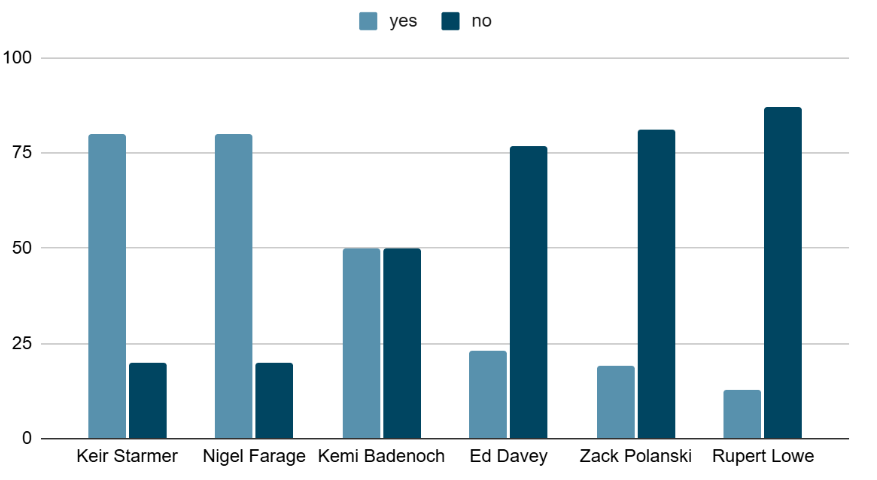
80% of people could identify Keir Starmer while astonishingly 20% could not, surprisingly, it was the exact same result for Nigel Farage.
Kemi Badenoch was evenly split with 50% positively identifying her and 50% unable to do so.
Ed Davey could only be named by 23% of people with the other 77% having no idea who he is. Similarly Zack Polanski was only recognisable to 19% with 81% again unable to name him. Finally Rupert Lowe was recognisable to only 13% and unknown to 87%.
“Next year, we are aiming to stand in every single council seat across the county” - Rupert Lowe via Instagram.
Although Lowe ` s party Restore is relatively new and its main reach is in his own constituency of Great Yarmouth, I was interested to see how impressionable he is given the swathes of people becoming members of Restore nationally. Clearly the party has some way to go to reach voters on a national level.
Interestingly, the people I ` quizzed` all live in a Liberal Democrat constituency, and before the 2024 general election the position was held by a conservative, yet the majority of the people I asked could not identify the leader of either party. So if we don` t know who our political leaders are then how will we know what they and their party stand for and in turn if we know none of this then how can we make an informed decision at the ballot box?
The latest IPSOS poll on voting intention has reform leading with 25%, followed by Labour and the Conservatives who both have 19% of the vote share, the Green party are at 17% and the Lib Dems at 14%. The remaining 6%, designated as ` other` will contain independent and small parties including Rupert Lowe and Restore
When the Labour party won the 2024 General election, they won primarily due to the country`s frustration with the previous Conservative government and at that time Keir Starmer promised change. However, since then it feels as though nothing has changed but that in fact everything has gotten much worse.
The party proclaiming to be for the working people has lost their trust. They alienated their core voter with policies they claimed would better the lives of Britain's working class which instead did nothing but harm them.
Hike in employers national insurance contribution
Increasing the National minimum wage for over 21s to £12.71 and for 18-20 year olds to £10.85
Plan to increase fuel duty for all consumers even in the face of an ongoing conflict in the middle east
These are just some of the actions from the government that have created a rift. A sense of them and us. The government and the people. Evidently there will be a huge political shift after the local elections. The question is are we going to move back to the right or further to the left.
The role of social media:
Last month, following the conservative Spring conference I looked at each of the political parties Instagram accounts and their number of followers.
At the beginning of March the figures were:
Green - 489k
Reform - 342k
Labour - 341k
Conservatives - 289k
Restore - 161k
Liberal democrats - 110k
I then decided to look again this week and make a comparison.
Had the political turmoil over the previous six weeks as well as the ongoing conflict in Iran impacted the implied support of each of the main political parties?
As of April 20th the figures were:
Green - 510k
Labour - 345k
Reform - 343k
Conservatives - 293k
Restore - 186k
Liberal democrats - 115k
Not all of the accounts following each party will necessarily correlate to a vote. There will be some followers who live overseas. Some followers who are not yet of voting age in this country and there will also be some following each party on social media not out of support but out of curiosity.
Clearly we can see that each party has managed to attract more voters in the 6 week timeframe, indicating more people are engaging with politics on social media. But this engagement is primarily with 10, 20 and 30 second clips designed to draw your interest for a brief time. This level of interaction with politics, in my personal opinion, does not provide enough information about a party to help you truly understand who you are voting for.
With the local elections coming up in a matter of weeks the question must be asked : are we well enough informed to make a decision at the ballot box or is social media leading over fact?
